




















GTA San Andreas in Browser
You step off a bus on Grove Street in GTA San Andreas, and before you reach the corner a patrol car pulls up, two crooked cops take your cash and leave you on the wrong side of town with a stolen bicycle. It is 1992, Carl Johnson has just come back from Liberty City for his mother's funeral, and the neighborhood he left five years ago is falling apart around his family. What follows is a story that crosses three cities, a desert and miles of countryside, and with GTA San Andreas in Browser every part of it opens in a single tab on your computer.
Grove Street, 1992
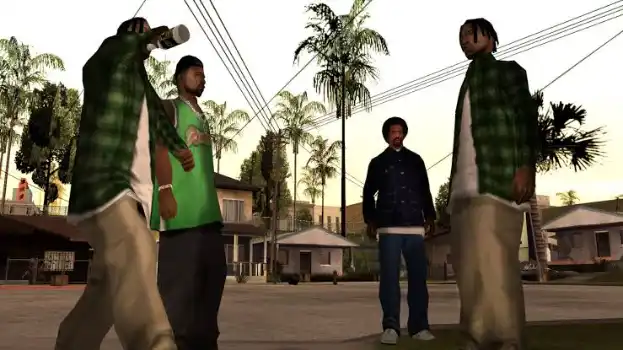
Grove Street is a small cul-de-sac in Ganton, and it used to be the heart of the Grove Street Families. By the time CJ returns, the Ballas and the Los Santos Vagos have taken most of the surrounding blocks, drugs have split the old crew, and his brother Sweet still blames him for leaving. The first job is not a heist or a shootout but a bike ride with Sweet, Big Smoke and Ryder, which says a lot about the kind of story this is.
Those early missions rebuild the neighborhood piece by piece. CJ sprays Grove tags over rival graffiti, buys his first gun, joins a drive-by and meets Cesar Vialpando, the leader of the Varrios Los Aztecas who is dating his sister Kendl. Officer Frank Tenpenny keeps turning up with jobs CJ cannot refuse, and the feeling grows that not everyone on Grove Street is who they seem. Players who care about characters tend to fall for GTA San Andreas right here, long before the map opens up.
The emotional hook is what most fans remember. Each block belongs to someone CJ knows, likes or hates, so even a quick drive to the shop feels personal, and the radio fills the gaps with Radio Los Santos, K-DST, Bounce FM and the endless talk shows of WCTR.
| What kind of ride it is | Open-world crime action with driving, shooting, gang wars and character stats |
|---|---|
| Where you can play | Desktop browsers with keyboard and mouse, or a gamepad for flying and long drives |
| Your daily routine | Missions for family and allies, turf wars, side jobs, schools and races |
| Who you will meet | CJ, Sweet, Kendl, Big Smoke, Ryder, Cesar, Tenpenny, Woozie, Mike Toreno |
| The setting | A whole state in 1992: Los Santos, San Fierro, Las Venturas and five rural counties |
| How much there is | One long campaign, 100 tags, 50 snapshots, 50 horseshoes, 50 oysters and 70 stunt jumps |
How GTA San Andreas in Browser Works
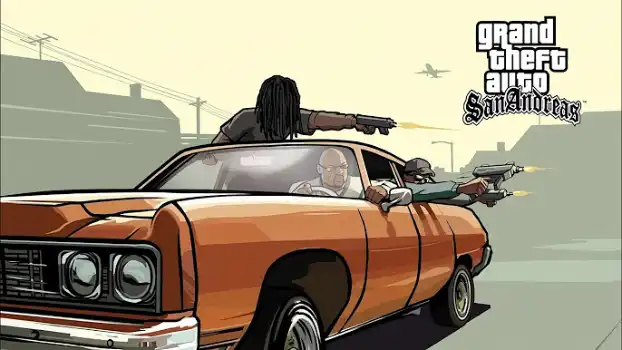
The browser version follows CJ's story mission by mission, with the familiar cities, vehicles and radio stations, and it starts without an installer. Desktop players get the classic PC layout: WASD to move, the mouse to look and aim, Space to sprint, Left Shift to jump and F to get in or out of a vehicle. In cars the mouse wheel changes the radio, Space becomes the handbrake and the 2 key starts side jobs such as Paramedic or Vigilante.
Before your first mission: switch on hardware acceleration in the browser settings and open the page in fullscreen. The radar, the wanted stars and the stats bars all need room, and a steady frame rate matters most during chases through Los Santos and the flying tests in the desert.
A gamepad is worth plugging in if you have one. Keyboard flying works, but analog sticks make the Pilot School tests and the long countryside drives far more forgiving, and they help with the bike stunts on Mount Chiliad as well.
Because nothing has to be installed, the page works on school laptops, work computers and borrowed machines alike. Many players fit a mission or two into a lunch break, while others come back years after the PS2 release simply to see whether Grove Street feels the way they remember. The full key list lives on the controls page, along with a few habits that make sprinting and aiming easier.
CJ's Story Across the State
The campaign is one long arc that pushes CJ out of his neighborhood and then brings him back. Each chapter has its own city, its own allies and its own music, which keeps a very long story from feeling repetitive. The broad shape looks like this:
- Back on Grove Street. CJ rejoins the gang, retakes the neighborhood and starts to suspect that someone close is working with the enemy.
- Betrayal. A trap at the end of the Los Santos chapter leaves Sweet in custody and CJ dumped in the countryside by Tenpenny.
- The Badlands. Robberies with the hot-headed Catalina and jobs for a hippie called The Truth fill the time in Red County.
- San Fierro. CJ runs a garage in Doherty, teams up with Woozie's Triads and works against the Loco Syndicate.
- The desert and Las Venturas. Mike Toreno's strange jobs lead to an airstrip at Verdant Meadows, then to the casinos and a heist at Caligula's.
- Home again. CJ returns to Los Santos to rebuild Grove Street and settle accounts with Big Smoke and Tenpenny.
What makes the story work is the pacing. Early missions are short and local, mostly around Ganton, Idlewood and Jefferson, so the first evening never feels overwhelming. Later chapters mix heists, races, flights and chases across the whole state, and the story walkthrough covers each one, including the handful of missions that cause most retries.
Failure is cheap, which helps newcomers. A failed job simply sends you back to the marker, and the only real losses come from getting busted or wasted, which takes away the weapons you were carrying. Safehouses are where you save, starting with the Johnson house on Grove Street.
Stats, Gyms and Respect
This chapter was the first in the series to give its hero a body that changes. What CJ eats, how he gets around and which weapons he uses all leave a mark, and those numbers decide how well he runs, fights, shoots and drives. The main ones to watch are:
- Stamina rises with running, cycling and swimming, and decides how long CJ can sprint.
- Muscle comes from the gyms and makes every punch and kick hit harder.
- Fat builds up from Cluckin' Bell and Burger Shot meals eaten without exercise.
- Respect grows with gang work and sets how many recruits follow CJ.
- Weapon skills improve with use and unlock dual pistols and faster reloads.
- Driving and Flying skills steady the handling of cars, bikes and planes.
Beginners usually ignore all of it and wonder why CJ runs out of breath halfway through a chase. A few visits to the gym and a habit of cycling everywhere fix that quickly. The gyms in Ganton, Garcia and Redsands East each teach a new fighting style, which changes how CJ handles street brawls for the rest of the story.
The stat system divides opinion. Role-playing fans love shaping CJ, while others find skill requirements a chore, especially the flying tests in the desert. The stats and side jobs guide explains which numbers matter and how to raise them without grinding.
Gang Wars and the Streets of Los Santos
Los Santos is divided into colored zones. Green belongs to Grove Street, purple to the Ballas and yellow to the Vagos, and CJ can start a war by killing rival members inside their turf and then surviving three waves of defenders. Recruits follow him into the fight and even ride along for drive-bys, which turns a lonely shootout into a proper street battle.
Turf wars are optional for a while, but the colors of the map matter again when CJ comes home at the end of the story. Painting Los Santos green early makes that final chapter much smoother. Speedrunners take only what the story demands, while completionists paint every block before heading to San Fierro.
Many players treat gang wars as a hobby of their own, clearing district after district long after the credits. The gang wars guide covers the best weapons, how to use recruits and how to hold turf once it is taken.
Three Cities and the Countryside
The state is far bigger than any earlier map in the series. Los Santos in the southeast is the sprawling home city, from the beaches of Santa Maria to the hills of Vinewood. San Fierro in the west is built on steep streets, bridges and fog, and Las Venturas in the northeast is all neon, casinos and desert highways. Between them lie farms, forests, small towns and Mount Chiliad, the tallest peak on the map.
The other cities stay locked until the story reaches them, and crossing into a closed region early brings a heavy wanted level. Once a chapter opens the way, the countryside becomes one of the best parts of the game. Back roads through Flint County and Red County are perfect for testing a new car, and the ghost towns and desert airstrips hide some of the strangest corners of the state.
Explorers who like to take the long way get more out of this map than anyone else. The San Andreas map guide marks every region, safehouse and service, so it is easy to plan a road trip that ends at the next mission marker.
Each city also has its own rhythm. Los Santos is about gang turf and family, San Fierro about cars, bridges and tight hills, and Las Venturas about money, with casinos and business income that finally make cash stop being a worry. Moving between them feels less like changing levels and more like a long road trip with CJ at the wheel.
Side Jobs and Schools That Pay Off
Some side content grants permanent upgrades, which makes the rest of the campaign much easier. The vehicle jobs are the best example, since each one is finished in a single run and pays off for the rest of the playthrough.
| Side job | Target | Permanent reward |
|---|---|---|
| Paramedic | Level 12 | Higher maximum health |
| Vigilante | Level 12 | Maximum armor raised to 150 |
| Firefighter | Level 12 | CJ becomes fireproof |
| Taxi Driver | 50 fares | Nitro and a hop in every taxi |
| Burglary | $10,000 of loot | Endless sprinting |
The schools are a separate track. The Driving School in San Fierro is part of the story, the Pilot School at Verdant Meadows is required before the desert chapter can finish, and the Bike and Boat Schools reward gold medals with better vehicles. Each one teaches skills that make later missions easier, even when the tests feel strict.
Leaving the vehicle or failing a level resets a vehicle job, so it pays to start with full health and a fresh car. Paramedic in particular rewards smooth driving, because patients only count once they are on board, and a rough ride wastes seconds that later levels do not forgive.
Stars, Roadblocks and Pay 'n' Spray
Every crime adds heat, and the wanted meter climbs to six stars. One or two stars send patrol cars that are easy to outrun, but shooting back or ramming a cruiser pushes the level up fast. Higher levels bring helicopters, roadblocks and spike strips, then SWAT teams, FBI agents and finally soldiers with tanks, and at that point the smartest move is usually to disappear rather than fight.
There are a few reliable ways out. Police bribe badges hidden around the state each remove one star, a Pay 'n' Spray repaints the car and clears the meter, and staying out of sight long enough lets low levels fade on their own. In the countryside, ducking off the highway onto a dirt road often loses pursuers faster than any city alley.
Getting busted costs the weapons CJ was carrying plus some cash, and he reappears outside a police station. That is why careful players buy only what a mission needs and keep the heavy guns for gang wars. Cheaters have their own shortcut too, and the cheat code list covers the wanted level codes along with weapons, vehicles, weather and the stranger world codes.
Guns, Cars and Planes Worth Knowing
Weapons come from Ammu-Nation stores in every city, from enemies after a fight and from pickups around the state, while collectible rewards stock the safehouses over time. Pistols, shotguns, submachine guns, rifles, sniper rifles and heavy weapons such as the rocket launcher and minigun all have their place, and raising a weapon skill to Hitman level with pistols or the Uzi lets CJ fire two at once.

Vehicles matter even more, because the map is so large. The Infernus and Turismo rule the highways, the Sanchez climbs hills that stop cars, the NRG-500 is the bike of choice for stunt jumps, and lowriders like the Savanna bounce on hydraulics in Cesar's contests. The BMX is still the quickest way through the tight alleys of Ganton.
The air opens up in the desert chapter, from the little Dodo to the Hydra jet and the Hunter helicopter, and the jetpack from Black Project turns rooftops and mountain peaks into easy stops. Flying gets steadier as the Flying skill grows, so early flights feel shaky and later ones feel effortless. A Pay 'n' Spray repairs damage and shakes off the police, and safehouse garages keep a favorite ride ready near each mission start.
What Veterans Do Differently in GTA San Andreas
Experienced players front-load the permanent rewards and build CJ's stats before the hardest chapters. Their advice usually sounds something like this:
Pro Tip: Do Paramedic before leaving Los Santos. The extra health makes the Badlands robberies and the San Fierro shootouts far less punishing.
Pro Tip: Before a long mission, eat one meal, not three. A single burger keeps CJ from starving without stacking fat that slows his climbing and sprinting.
Pro Tip: Take the Dodo around the airstrip a few times before the Pilot School tests. Flying skill rises with use, and the plane steadies noticeably.
Pro Tip: Start gang wars at night near Grove Street, where more rivals are out and the Johnson house is close for a quick rearm between waves.
Collectors follow the story order. The 100 tags belong to Los Santos, the 50 snapshots to San Fierro and the 50 horseshoes to Las Venturas, while the 50 oysters hide underwater across the state. Each set unlocks rewards such as weapons at safehouses, better luck at the casinos or extra lung capacity.
Completionists add the schools, the races, the freight train and the trucking runs on top of that. The collectibles guide lays out every set and its reward, and the jetpack makes the rooftop pieces much quicker once it arrives.
Arguments That Never End
Nobody agrees on the hardest mission. Wrong Side of the Tracks, where CJ drives Big Smoke alongside a train full of Vagos, gets the most votes, but the Pilot School, the RC plane jobs at Zero's shop and some of the later heists all have loud supporters.
Editor's note: The train mission is about pace, not speed. Stay level with the carriage on the long straights and Big Smoke does the rest.
Our take: The flight school is strict, but passing it is also the moment the whole state opens up. Most players who struggle there end up spending an evening just flying the Dodo over the desert.
From the radio: Radio Los Santos on a lowrider through Ganton is a pairing fans still bring up, while K-Rose and WCTR reward anyone who keeps driving long enough to hear a full segment.
The stat system splits people too. Some love that CJ changes with every meal and workout, while others see the grind as filler between story missions. A newer debate concerns the browser version itself: some fans want mods and widescreen fixes on a modern PC, while others love that a borrowed laptop can now run the whole campaign without setup.
Then there is the question of what to play next. Some people go straight back for 100%, others start a new run with different gang war habits, and plenty look for something with the same mix of driving and shootouts. For those evenings, the list of similar picks collects gangster, car, gun and sandbox titles with the same attitude.
Questions From First-Time Players
These are the questions that come up most often from people trying the browser edition for the first time. Most of them are about the same few hurdles: one train mission, one flying school and the side jobs that make the rest of the story easier.
Is this the complete GTA San Andreas story?
Yes, the campaign runs from CJ's return to Grove Street through the Badlands, San Fierro, the desert and Las Venturas to the final chapter back in Los Santos. Side jobs, schools, gang wars and collectibles are all part of it.
Can I play GTA San Andreas in Browser on a phone or tablet?
The page opens in modern mobile browsers, but this is a keyboard-and-mouse game at heart. A tablet in landscape mode with a Bluetooth gamepad or keyboard gives the most comfortable result, and a desktop or laptop remains the best way to play.
Does it run on a Chromebook or an older laptop?
Usually yes, as long as hardware acceleration is switched on in the browser. Closing heavy tabs and using fullscreen keeps Los Santos smooth during busy chases.
How do you beat Wrong Side of the Tracks?
Stay level with the train rather than racing ahead, so Big Smoke has a steady shot at the Vagos on board. The long straight sections are the best moments to close the gap and let him fire.
How do you pass the Pilot School?
Practice first. Short flights in the Dodo raise the Flying skill and make every plane steadier, and a gamepad helps a lot with the tight landing and turning tests at Verdant Meadows.
Which side job should I finish first?
Paramedic is the strongest early pick because extra health makes every later mission safer. Burglary comes next for endless sprinting, and Vigilante is worth finishing before the final chapter for the armor.
How do cheat codes work here?
Codes such as HESOYAM for health, armor and cash or AEZAKMI to stay off the police radar are typed on the keyboard during play. Keep a separate save for experiments, because some codes can make a story run messy.
Why can't I reach San Fierro or Las Venturas yet?
The other cities open as the story reaches them, and crossing into a closed region early brings a heavy wanted level. Finish the countryside chapter for San Fierro and the desert chapter for Las Venturas.
A whole state, a family to protect and a soundtrack people still hum: GTA San Andreas in Browser keeps all of that one click away, whether you want a lowrider cruise through Ganton, a jetpack flight over Mount Chiliad or one more try at keeping pace with the train beside Big Smoke.